A metallurgical analysis of steel taken from the hull of the Titanic's wreckage reveals that it had a high ductile-brittle transition temperature, making it unsuitable for service at low temperatures; at the time of the collision, the temperature of the sea water was -2°C. The analysis also shows, however, that the steel used was probably the best plain carbon ship plate available at the time of the ship's construction.
INTRODUCTION
In the early part of this century, the only means of transportation for travelers and mail between Europe and North America was by passenger steamship. By 1907, the Cunard Steamship Company introduced the largest and fastest steamers in the North Atlantic service: the Lusitania and the Mauritania. Each had a gross tonnage of 31,000 tons and a maximum speed of 26 knots. In that year, Lord William James Pirrie, managing director and controlling chair of the Irish shipbuilding company Harland and Wolff, met with J. Bruce Ismay, managing director of the Oceanic Steam Navigation Company, better known as the White Star Line (a name taken from its pennant). During this meeting, plans were made to construct three enormous new White Star liners to compete with the Lusitania and Mauritania on the North Atlantic by establishing a three-ship weekly steamship service for passengers and mail between Southampton, England, and New York City. This decision required the construction of a trio of luxurious steamships. The first two built were the RMS Olympic and the RMS Titanic; a third ship, the RMS Britannic, was built later
The Titanic began its maiden voyage to New York just before noon on April 10, 1912, from Southampton, England. Two days later at 11:40 p.m., Greenland time, it struck an iceberg that was three to six times larger than its own mass, damaging the hull so that the six forward compartments were ruptured. The flooding of these compartments was sufficient to cause the ship to sink within two hours and 40 minutes, with a loss of more than 1,500 lives. The scope of the tragedy, coupled with a detailed historical record, have fueled endless fascination with the ship and debate over the reasons as to why it did in fact sink. A frequently cited culprit is the quality of the steel used in the ship's construction. A metallurgical analysis of hull steel recovered from the ship's wreckage provides a clearer view of the issue.
THE CONSTRUCTION
The three White Star Line steamships were 269.1 meters long, 28.2 meters maximum wide, and 18 meters tall from the water line to the boat deck (or 53 meters from the keel to the top of the funnels), with a gross weight of 46,000 tons. Because of the size of these ships, much of the Harland and Wolff shipyard in Belfast, Ireland, had to be rebuilt before construction could begin; two larger ways were built in the space originally occupied by three smaller ways. A new gantry system with a larger load-carrying capacity was designed and installed to facilitate the construction of the larger ships. The Titanic under construction at the shipyard is shown in Figure 1.
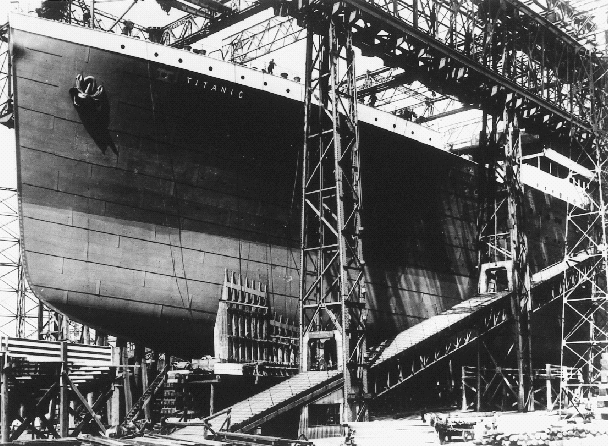 |
| Figure 1. The Titanic under construction at the Harland and Wolff shipyard in Ireland. (Photo courtesy of the Titanic Historical Society.) |
The ships were designed to provide accommodations superior to the Cunard ships, but without greater speed. The first on-board swimming pools were installed as was a gymnasium that included an electric horse and an electric camel, a squash court, a number of rowing machines, and stationary bicycles, all supervised by a staff of professional instructors. The public rooms for the first-class passengers were large and elegantly furnished with wood paneling, stained-glass windows, comfortable lounge furniture, and expensive carpets. The decor of the first class cabins, in addition to being luxurious, differed in style from cabin to cabin. As an extra feature on the Titanic, the Café Parisienne offered superb cuisine.
The designed speed for these ships was 21-22 knots, in contrast to the faster Cunard ships. To achieve this speed, each ship had three propellers; each outboard propeller was driven by a separate four-cylinder, triple expansion, reciprocating steam engine. The center propeller was driven by a low-pressure steam turbine using the exhaust steam from the two reciprocating engines. The power plant was rated at 51,000 I.H.P. To provide the necessary steam for the power plant, 29 boilers were available, fired by 159 furnaces. In addition to propelling the ship, steam was used to generate electricity for various purposes, distill fresh water, refrigerate the perishable food, cook, and heat the living space. Coal was burned as fuel at a rate of 650 tons per day when the ship was underway. Stokers moved the coal from the bunkers into the furnaces by hand. The bunkers held enough coal for a ten-day voyage.
| THE LIVES OF THE SISTER SHIPS |
|---|
| The RMS Olympic made more than 500 round trips between Southampton and New York before it was retired in 1935 and was finally broken up in 1937. In 1919, it became the first large ship to be converted from coal to oil. On May 15, 1934, as the Olympic approached New York, it struck the Nantucket light ship during a heavy fog, cutting it in half. Of the crew, four were drowned, three were fatally injured, and three were rescued. The third ship of the series, the Britannic, had a short life. While it was being constructed, the Titanic was sunk. Immediately, the design was changed to provide a double hull and the bulkheads were extended to the upper deck. Before the Britannic was completed, World War I broke out, and the vessel was converted into a hospital ship. On November 21, 1916, it was proceeding north through the Aegean Sea east of Greece when it struck a mine. Because the weather had been warm, many of the portholes had been opened, hence rapid flooding of the ship occurred. The ship sank in 50 minutes with a small loss of life; one of the loaded life boats was drawn into a rotating propeller. |
The remodeled shipyard at Harland and Wolff was large enough for the construction of two large ships simultaneously. The keel of the Olympic was laid December 16, 1908, while the Titanic's keel followed on March 31, 1909. The Olympic was launched on October 20, 1910, and the Titanic on May 31, 1911. In the early 20th century, ships were constructed using wrought-iron rivets to attach steel plates to each other or to a steel frame. The frame itself was held together by similar rivets. Holes were punched at appropriate sites in the steel-frame members and plates for the insertion of the rivets. Each rivet was heated well into the austenite temperature region, inserted in the mated holes of the respective plates or frame members, and hydraulically squeezed to fill the holes and form a head. Three million rivets were used in the construction of the ship.
The construction of the Titanic was delayed due to an accident involving the Olympic. During its fifth voyage, the Olympic collided with the British cruiser, HMS Hawke, damaging its hull near the bow on the port (left) side. This occurred in the Solent off Southampton on September 20, 1911. The Olympic was forced to return to Belfast for repairs. To accomplish the repairs in record time and to return the ship to service promptly, workmen were diverted from the Titanic to repair the Olympic.
On April 2, 1912, the Titanic left Belfast for Southampton and its sea trials in the Irish Sea. After two days at sea, the Titanic, with its crew and officers, arrived at Southampton and tied up to Ocean Dock on April 4. During the next several days, the ship was provisioned and prepared for its maiden voyage.
THE VOYAGE
On the morning of April 10, 1912, the passengers and remaining crew members came to Ocean Dock to board the ship for its maiden voyage. Shortly before noon, the Titanic cast off and narrowly avoided colliding with a docked passenger ship, the New York (which broke its mooring cables due to the surge of water as the huge ship passed), before proceeding down Southampton Water into the Solent and then into the English Channel. After a stop at Cherbourg, France, on the evening of April 10th and a second stop at Queenstown (now Cobh), Ireland, the next morning to take on more passengers and mail, the Titanic headed west on the Great Circle Route toward the Nantucket light ship 68 kilometers south of Nantucket Island off the southeast coast of Massachusetts. The Irish coast was left behind about dusk on April 11.
| Table I. A Summary of Damaged Areas in Hull by Compartment* | |
|---|---|
| Compartment | Computer Calculations (m2) |
| Fore Peak Cargo Hold 1 Cargo Hold 2 Cargo Hold 3 Boiler Room 6 Boiler Room 5 Total Area | 0.056 0.139 0.288 0.307 0.260 0.121 1.171 |
| *The compartments are listed in order from the bow toward the stern. | |
During the early afternoon of April 12, the French liner, La Touraine, sent advice by radio of ice in the steamship lanes, but this was not uncommon during an April crossing. This advice was sent nearly 60 hours before the fatal collision. As the voyage continued, the warnings of ice received by radio from other ships became more frequent. With time, these warnings gave more accurate information on the location of the icefields and it became apparent that a very large icefield lay in the ship's course. On the basis of several reports after the accident, it was estimated that the icefield was 120 km long on a northeast-southwest axis and 20 km wide; there is evidence that the Titanic was twice diverted to the south in a vain effort to avoid the fields. The ship continued at a speed of about 21.5 knots.
On the moonless night of April 14, the ocean was very calm and still. At 11:40 p.m., Greenland time, the lookouts in the crow's nest sighted an iceberg immediately ahead of the ship; the bridge was alerted. The duty officer ordered the ship hard to port and the engines reversed. In about 40 seconds, as the Titanic was beginning to respond to the change in course, it collided with an iceberg estimated to have a gross weight of 150,000-300,000 tons. The iceberg struck the Titanic near the bow on the starboard (right) side about 4 m above the keel. During the next 10 seconds, the iceberg raked the starboard side of the ship's hull for about 100 m, damaging the hull plates and popping rivets, thus opening the first six of the 16 watertight compartments formed by the transverse bulkheads. Inspection shortly after the collision by Captain Edward Smith and Thomas Andrews, a managing director and chief designer for Harland and Wolff and chief designer of the Titanic, revealed that the ship had been fatally damaged and could not survive long. At 2:20 a.m., April 15, 1912, the Titanic sank with the loss of more than 1,500 lives.
THE SINKING
Initial studies of the sinking proposed that a continuous gash in the hull 100 m in length was created by the impact with the iceberg. More recent studies indicate that discontinuous damage occurred along the 100 m length of the hull. After the sinking, Edward Wilding, design engineer for Harland and Wolff, estimated that the collision had created openings in the hull totaling 1.115 m2, based on the reports of the rate of flooding given by the survivors. This damage to the hull was sufficient to cause the ship to sink. Recent computer calculations by Hackett and Bedford using the same survivors' information, but allocating the damage individually to the first six compartments that were breached, is given in Table I. This shows a total damage area of 1.171 m2, which is a slightly larger area than the estimate by Wilding.
At the time of the accident, there was disagreement among the survivors as to whether the Titanic broke into two parts as it sank or whether it sank intact. On September 1, 1985, Robert Ballard found the Titanic in 3,700 m of water on the ocean floor. The ship had broken into two major sections, which are about 600 m apart. Between these two sections is a debris field containing broken pieces of steel hull and bulkhead plates, rivets that had been pulled out, dining room cutlery and chinaware, cabin and deck furniture, and other debris.
The only items to survive at the site are those made of metals or ceramics. All items made from organic materials have long since been consumed by scavengers, except for items made from leather such as shoes, suitcases, and mail sacks; tanning made leather unpalatable for the scavengers. The contents of the leather suitcases and mail sacks, having been protected, have been retrieved and restored. Ethical and legal issues associated with the recovery of such items are described in the sidebar authored by C.R. McGill.
| Table II. The Composition of Steels from the Titanic, a Lock Gate, and ASTM A36 Steel | |||||||||
|---|---|---|---|---|---|---|---|---|---|
| C | Mn | P | S | Si | Cu | O | N | MnS: Ratio | |
| Titanic Hull Plate | 0.21 | 0.47 | 0.045 | 0.069 | 0.017 | 0.024 | 0.013 | 0.0035 | 6.8:1 |
| Lock Gate* | 0.25 | 0.52 | 0.01 | 0.03 | 0.02 | — | 0.018 | 0.0035 | 17.3:1 |
| ASTM A36 | 0.20 | 0.55 | 0.012 | 0.037 | 0.007 | 0.01 | 0.079 | 0.0032 | 14.9:1 |
| *Steel from a lock gate at the Chittenden ship lock between Lake Washington and Puget Sound, Seattle, Washington. | |||||||||
THE STEEL
Composition
 |
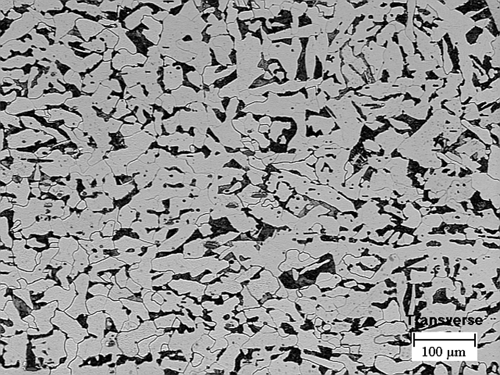 |
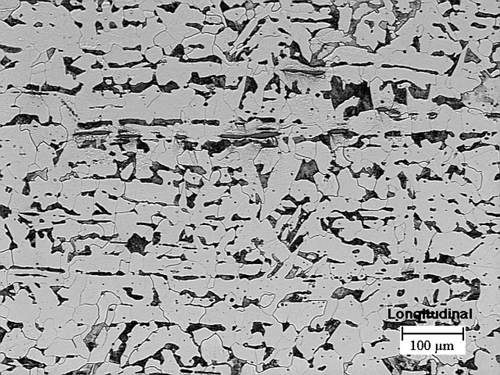
| Figure 2. An optical micrograph of steel for the hull of the Titanic in (a—top) longitudinal and (b—bottom) transverse directions, showing banding that resulted in elongated pearlite colonies and MnS particles. Etchant is 2% Nital. |
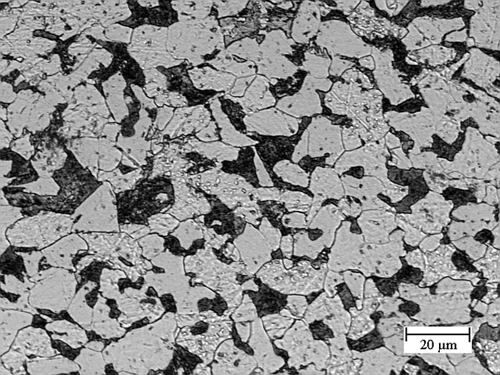 |
| Figure 3. The microstructure of ASTM A36 steel showing ferrite and pearlite. The mean grain diameter is 26.173 µm. Etchant is 2% Nital. |
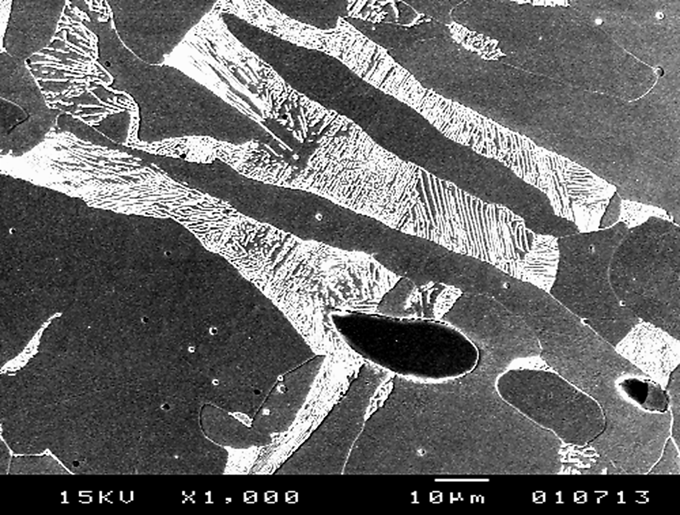 |
| Figure 4. A scanning electron micrograph of the etched surface of the Titanic hull steel showing pearlite colonies, ferrite grains, an elongated MnS particle, and nonmetallic inclusions. Etchant is 2% Nital. |
 |
| Figure 5. A scanning electron micrograph of a Charpy impact fracture surface newly created at 0°C, showing cleavage planes containing ledges and protruding MnS particles. |
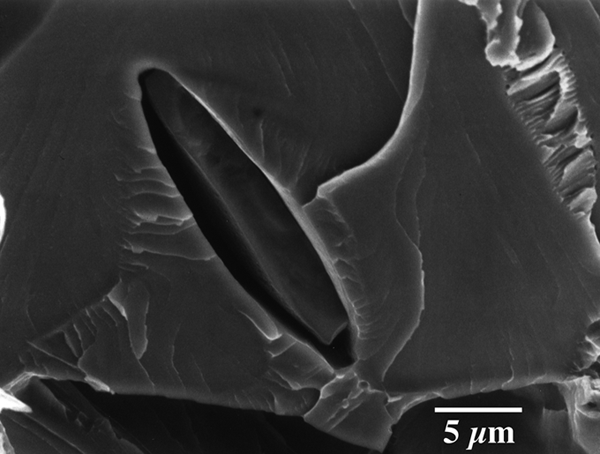 |
| Figure 6. A scanning electron micrograph showing a fractured MnS particle protruding edge-on from the fracture surface. |
During an expedition to the wreckage in the North Atlantic on August 15, 1996, researchers brought back steel from the hull of the ship for metallurgical analysis. After the steel was received at the University of Missouri-Rolla, the first step was to determine its composition. The chemical analysis of the steel from the hull is given in Table II. The first item noted is the very low nitrogen content. This indicates that the steel was not made by the Bessemer process; such steel would have a high nitrogen content that would have made it very brittle, particularly at low temperatures. In the early 20th century, the only other method for making structural steel was the open-hearth process. The fairly high oxygen and low silicon content means that the steel has only been partially deoxidized, yielding a semikilled steel. The phosphorus content is slightly higher than normal, while the sulfur content is quite high, accompanied by a low manganese content. This yielded a Mn:S ratio of 6.8:1—a very low ratio by modern standards. The presence of relatively high amounts of phosphorous, oxygen, and sulfur has a tendency to embrittle the steel at low temperatures.
Davies has shown that at the time the Titanic was constructed about two-thirds of the open-hearth steel produced in the United Kingdom was done in furnaces having acid linings. There is a high probability that the steel used in the Titanic was made in an acid-lined open-hearth furnace, which accounts for the fairly high phosphorus and high sulfur content. The lining of the basic open-hearth furnace will react with phosphorus and sulfur to help remove these two impurities from the steel. It is likely that all or most of the steel came from Glasgow, Scotland.
Included in Table II are the compositions of two other steels: steel used to construct lock gates at the Chittenden Ship Lock between Lake Washington and Puget Sound at Seattle, Washington, and the composition of a modern steel, ASTM A36. The ship lock was built around 1912, making the steel about the same age as the steel from the Titanic.
Metallography
Standard metallographic techniques were used to prepare specimens taken from the hull plate of the Titanic for optical microscopic examination. After grinding and polishing, etching was done with 2% Nital. Because earlier work by Brigham and Lafrenière showed severe banding in a specimen of the steel, specimens were cut from the hull plate in both the transverse and longitudinal directions. Figure 2 shows the microstructure of the steel. In both micrographs, it is apparent that the steel is banded, although the banding is more severe in the longitudinal section. In this section, there are large masses of MnS particles elongated in the direction of the banding. The average grain diameter is 60.40 µm for the longitudinal microstructure and 41.92 µm for the microstructure in the transverse direction. In neither micrograph can the pearlite be resolved. For comparison, Figure 3 is a micrograph of ASTM A36 steel, which has a mean grain diameter of 26.173 µm.
Figure 4 is a scanning electron microscopy (SEM) micrograph of the polished and etched surface of steel from the Titanic. The pearlite can be resolved in this micrograph. The dark gray areas are ferrite. The very dark elliptically shaped structure is a particle of MnS identified by energy-dispersive x-ray analysis (EDAX). It is elongated in the direction of the banding, suggesting that banding is the result of the hot rolling of the steel. There is some evidence of small nonmetallic inclusions and some of the ferrite grain boundaries are visible.
Tensile Testing
The steel plate from the hull of the Titanic was nominally 1.875 cm thick, while the bulkhead plate had a thickness of 1.25 cm. Corrosion in the salt water had reduced the thickness of the hull plate so that it was not possible to machine standard tensile specimens from it. A smaller tensile specimen with a reduced section of 0.625 cm diameter and a 2.5 cm gage length was used.
The tensile-test results are given in Table III. These data are compared with tensile-test data for an SAE 1020 steel, which is similar in composition. The steel from the Titanic has the lower yield strength, probably due to a larger grain size. The elongation increases as well, again due to a larger grain size.
Charpy Impact Tests
Charpy impact tests were performed over a range of temperatures from -55°C to 179°C on three series of standard Charpy specimens: a series of specimens machined with the specimen axis parallel to the longitudinal direction in the hull plate from the Titanic, a series machined in the transverse direction, and a series made from modern ASTM A36 steel. A Tinius Olsen model 84 universal impact tester was used to determine the impact energy to fracture for several specimens at the selected test temperatures. A chilling bath or a circulating air laboratory oven was used to prepare the specimens for testing at specific temperatures. The specimens were allowed to soak in the appropriate apparatus for at least 20 minutes at the selected temperature. Pairs of specimens were tested at identical test temperatures.
Figure 5 is an SEM micrograph of a freshly fractured surface of a longitudinal Charpy specimen tested at 0°C. The cleavage planes, (100) in ferrite, are quite apparent. There are cleavage plane surfaces at different levels that are defined by straight lines. These straight lines are steps connecting parallel cleavage planes; the edges are parallel to the [010] direction. The crystallographic surfaces of the risers are the (001) plane. In addition, there are curved slip lines on the cleavage planes.
Particles of MnS identified by EDAX can be observed. Some of the MnS particles exist as protrusions from the surface. These protrusions were pulled out of the complimentary fracture surface. In addition, there are the intrusions remaining after the MnS particles have been pulled out of this fracture surface. One of the pearlite colonies lying in the fracture surface is oriented so that the ferrite and cementite plates have been resolved. Figure 6 shows a fractured lenticular MnS particle that protrudes edge-on from the fractured surface. There are slip lines radiating away from the MnS particle.
| Table III. A Comparison of Tensile Testing of TitanicSteel and SAE 1020 | ||
|---|---|---|
| Titanic | SAE 1020 | |
| Yield Strength | 193.1 MPa | 206.9 MPa |
| Tensile Strength | 417.1 MPa | 379.2 MPa |
| Elongation | 29% | 26% |
| Reduction in Area | 57.1% | 50% |
Figure 7 is a plot of the impact energy versus temperature for the three series of specimens. At higher temperatures, the specimens prepared from the hull plate in the longitudinal direction have substantially better impact properties than for the transverse specimens. At low temperatures, the impact energy required to fracture the longitudinal and transverse specimens is essentially the same. The severe banding is certainly the cause of the differences in the impact energy to cause fracture at elevated temperatures. The specimens made from ASTM A36 steel have the best impact properties. The ductile-brittle transition temperature determined at an impact energy of 20 joules is -27°C for ASTM A36, 32°C for the longitudinal specimens made from the Titanic hull plate, and 56°C for the transverse specimens. It is apparent that the steel used for the hull was not suited for service at low temperatures. The seawater temperature at the time of the collision was -2°C.
Comparing the composition of the Titanic steel and ASTM A36 steel shows that the modern steel has a higher manganese content and lower sulfur content, yielding a higher Mn:S ratio that reduced the ductile-brittle transition temperature substantially. In addition, ASTM A36 steel has a substantially lower phosphorus content, which will also lower the ductile-brittle transition temperature. Jankovic found that the ductile-brittle transition temperature for the Chittenden lock gate steel was 33°C. The longitudinal specimens of the Titanic hull steel made in the United Kingdom and those specimens from the Chittenden lock steel made in the United States have nearly the same ductile-brittle transition temperature.
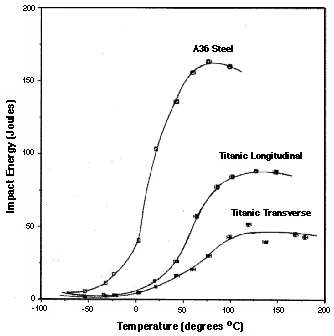 | 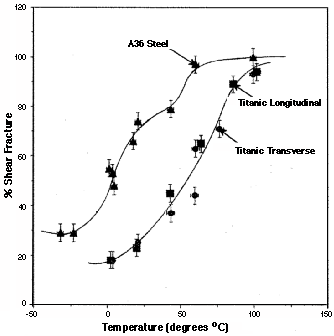 |
| Figure 7. Charpy impact energy versus temperature for longitudinal and transverse Titanic specimens and ASTM A36 steel. | Figure 8. Shear fracture percent from Charpy impact tests versus temperature for longitudinal and transverse Titanic specimens and ASTM A36 steel. |
Shear Fracture Percent
At low temperatures where the impact energy required for fracture is less, a faceted surface of cleaved planes of ferrite is observed, indicating brittle fracture. At elevated temperatures, where the energy to cause fracture is greater, a ductile fracture with a shear structure is observed. Figure 8 is a plot of the shear fracture percent versus temperature. There is a fairly strong similarity between this figure and Figure 7, which should be expected as they represent the different measurements of the same phenomenon. Using 50% shear fracture area as a reference point, this would occur in ASTM A36 at -3°C, while for the Titanic steel, this value would occur at 49°C in the longitudinal direction and at 59°C in the transverse direction. At elevated temperatures, the impact-energy values for the longitudinal Titanic steel is substantially greater than the transverse specimens, as shown in Figure 7. The difference between the longitudinal and transverse shear fracture percent from the Titanic is much smaller. This suggests that the banding is a more important factor in the results for the impact-energy experiment as compared with shear fracture percent.
CONCLUSIONS
The steel used in constructing the RMS Titanic was probably the best plain carbon ship plate available in the period of 1909 to 1911, but it would not be acceptable at the present time for any construction purposes and particularly not for ship construction. Whether a ship constructed of modern steel would have suffered as much damage as the Titanic in a similar accident seems problematic. Navigational aides exist now that did not exist in 1912; hence, icebergs would be sighted at a much greater distance, allowing more time for evasive action. If the Titanic had not collided with the iceberg, it could have had a career of more than 20 years as the Olympic had. It was built of similar steel, in the same shipyard, and from the same design. The only difference was a big iceberg.
ACKNOWLEDGEMENTS
The authors thank G. Tullock of RMS Titanic, Inc., for supplying the steel from the Titanic and W. Garzke, Jr., of Gibbs and Cox, for his assistance in securing the steel. Thanks to D. Brown and M.K. Johnson and their associates of Laclede Steel Company for the chemical analysis of the steel. S. Miller of the Electron Microscope Laboratory and associate professor C. Ramsay are thanked for their assistance. Thanks to T. Foecke of the Metallurgy Division, National Institute of Science and Technology, for providing Figure 6. Last, but certainly not least, the authors acknowledge the assistance of M. Roberson, J. Jones, G. Papen, and D. Murphy of the School of Mines and Metallurgy shop at the University of Missouri-Rolla for their valuable assistance in preparing specimens and providing technical support.

No comments:
Post a Comment